One coupled system: a home, a companion, a Circle, and a Project.
None of this exists yet — that is the point of founding capital. What follows is the designed member experience: written down in the Due Diligence Book, shown in a working demonstration, and built for D-Day. UP has invented almost nothing here. Its patterns are among the best-proven in the human record, chosen for their craft — and deliberately stripped of the attention-harvesting business models that usually drive them. What is new is not the parts but how they fit together.
Written for both readers: the funder weighing the design, and the future member wondering what life inside it will feel like.
Joining will itself produce a plan, a Circle, and a first action.
Most movements lose people in the gap between joining and contributing. UP's joining flow is designed to close that gap: affirming the Tenets produces a personal THRIVE Plan, a Circle, and a first action — the member is connected before they finish signing up. Membership will be free, and the first-year features free forever. UP will never charge for anything it once gave free, and no member is ever shut out of civic life by an inability to pay.
A member won't experience an architecture. They'll experience a rhythm.
The recurring anchor, in every kind of Circle, is CONNECT — a structured monthly meeting of about two and a half hours, run on a ten-part script: sharing news, recognising contribution, moving Projects forward, committing to next steps. The LocalCircle CONNECT is the original form. A GlobalCircle's CONNECT is a Summit; a ThemedCircle's may run online with hundreds — the same DNA at every scale.
ACE · the cultural register
ACE — Appreciative Collaborative Exploration — replaces point-scoring critique with building each other up. It works through the DARE cycle: Discover · Aspire · Refine · Empower, using a simple Ladder of Feedback — clarify first, then value, then concerns, then suggestions.
Peer support · the second universal role
Deliberate mentor pairings, members sharing resources with members, growth tracked openly and turned toward each other's success. A UP Circle is not a passive interest group. Its members are committed to one another.
ACE is also how the culture of scrutiny spreads: ideas must be sold to peers, and no one — not a Thought Leader, not the Chairman — advances a Project without earning the Circle's endorsement.
The system allows no exceptions, and that refusal is what makes the discipline real.
Everything a member needs, in one place.
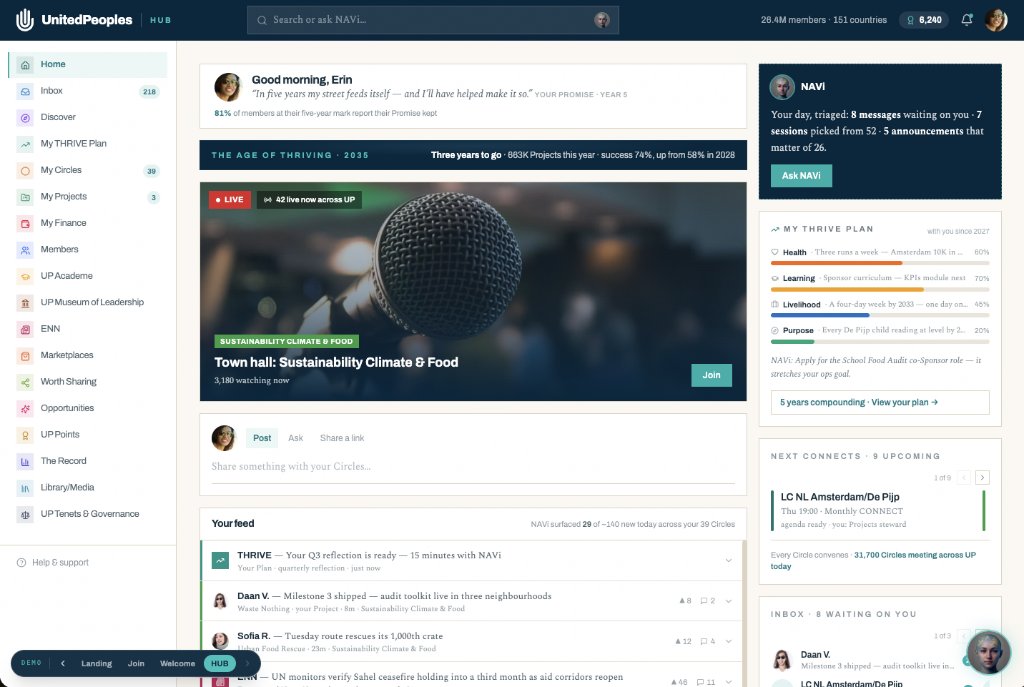
The UP HUB will be the member's home: one login, eighteen spaces — Circles, Projects, the THRIVE Dashboard, learning, news, marketplaces, money. It is not a mock-up: below is one page of a complete working demonstration you can walk end to end — joining, Circles, a live GlobalCircle, Projects in mid-flight, the THRIVE Plan, the Marketplace, ENN (UP's member news network), the Museum, UP Academe — with NAVi throughout.
The UP HUB as we imagine it in 2032. The architecture is designed; the members, Circles and Projects you'll meet are illustrative.
The companion that will make 100M feel personal.
A hundred million members cannot be coordinated with static tools and goodwill. Without intelligence in the middle, such a network becomes an audience, not a community. NAVi is that intelligence — more than any other part of the design, the gamechanger — built around eight roles and governed by hard rules fixed before a single member joins.

Live today · not a mock-up
It already exists as a working demonstration: the same voice, brain and face that will greet members. What is live today is the conversation; the coordination roles — matching, Circles, Projects, finance — arrive with D-Day and after. Meet it now, live, on this site.
The eight roles
Every member's front door — NAVi will greet, explain, and turn joining into a first plan and a first action.
It will help each member build and keep a living plan of personal growth and contribution.
It will connect members to the Circles, Projects and people where they fit — turning 100M-scale into coordination, not noise.
From idea to team to verified outcome, NAVi will carry the playbooks and the admin.
Projects rarely fail outright; they stall. NAVi is built to be unrelenting on exactly this — flagging what is slipping and re-engaging the work before neglect can kill it.
What works in one Circle is passed to the next; every verified Project sharpens the playbooks.
Help with voting, discussion and open records across the whole network.
Built into the planned banking and payments layer, under the strictest rules of all.
Four commitments worth naming
It is built for human connection, not for keeping you talking to it — where a peer, a mentor or the Circle would serve better, it sends the member there.
Authoritative on facts and process; questions of judgement and values go back to people.
Members set its voice, tone, language and manner — but member data belongs to the member and is never sold; privacy is built in; NAVi never pretends to be a person.
Memory and consent controlled by the member, enforced in the code itself — not promised in a policy that could drift.
NAVi is software — accountable machinery, called "it" by deliberate choice.
Belonging becomes work. Work becomes the record.
Four kinds of Circle — fifteen global domains, specialist communities, institutional hosts, and self-governing neighbourhood teams — all exist to produce one thing: Projects, endorsed by peers, sponsored, tracked and archived. Every verified Project sharpens the playbooks for the next. The system is designed to learn.
Where personal flourishing and systemic change become the same activity.
The THRIVE Plan is the cornerstone: each member's roadmap of personal growth and contribution — and, at the same time, a defined slot in UP's collective effort. A plan holding both "improve my public speaking" and "launch a community garden" works the same way for both — each goal tracked, supported and added up alike. And it is testable: every goal tagged to a domain Mission, every Project result rolling up into personal and collective impact numbers. Once UP is running, the Moonshot will either be on track on the dashboards or it will not — visible in real time.
Designed against both ways systems like this die.
The drift toward central control is checked by the constitution itself: authority spread across roles under explicit rules, with the independence of millions of LocalCircles built into the structure, not granted from above. The drift into fragments is checked by the Tenets as the common test, a tagging convention that keeps even independent work visible, and a College of 150 that holds the whole together by interpreting, not directing.
None of this is without precedent. AA grew self-governing peer groups to millions with no central administration. Rotary linked civic circles across countries. Mondragón proved that mission-locked economics endure. Congregations hold local meaning across generations. What is without precedent is the combination — with a digital coordination layer, banking built in, and Missions and Projects feeding each other in both directions.
How the architecture arrives — activation cadence, post-funding
D-Day — first three GlobalCircles launch, planned for the Peace Palace
Measure-and-refine window — no new activations
Monthly cadence begins — one GlobalCircle a month
Full deployment
LocalCircles — formal programme launch
There are no LocalCircles operating at scale in Year 1 — the architecture is explicit on the point.
How it is designed to work — reported from the tenth year.
The founder is writing the institution's tenth year before it exists — one dispatch per GlobalCircle, from March 2035, as field reporting: named people, named places, working numbers. Nothing in them has happened.
That is exactly their value — they are the designed institution, seen working.