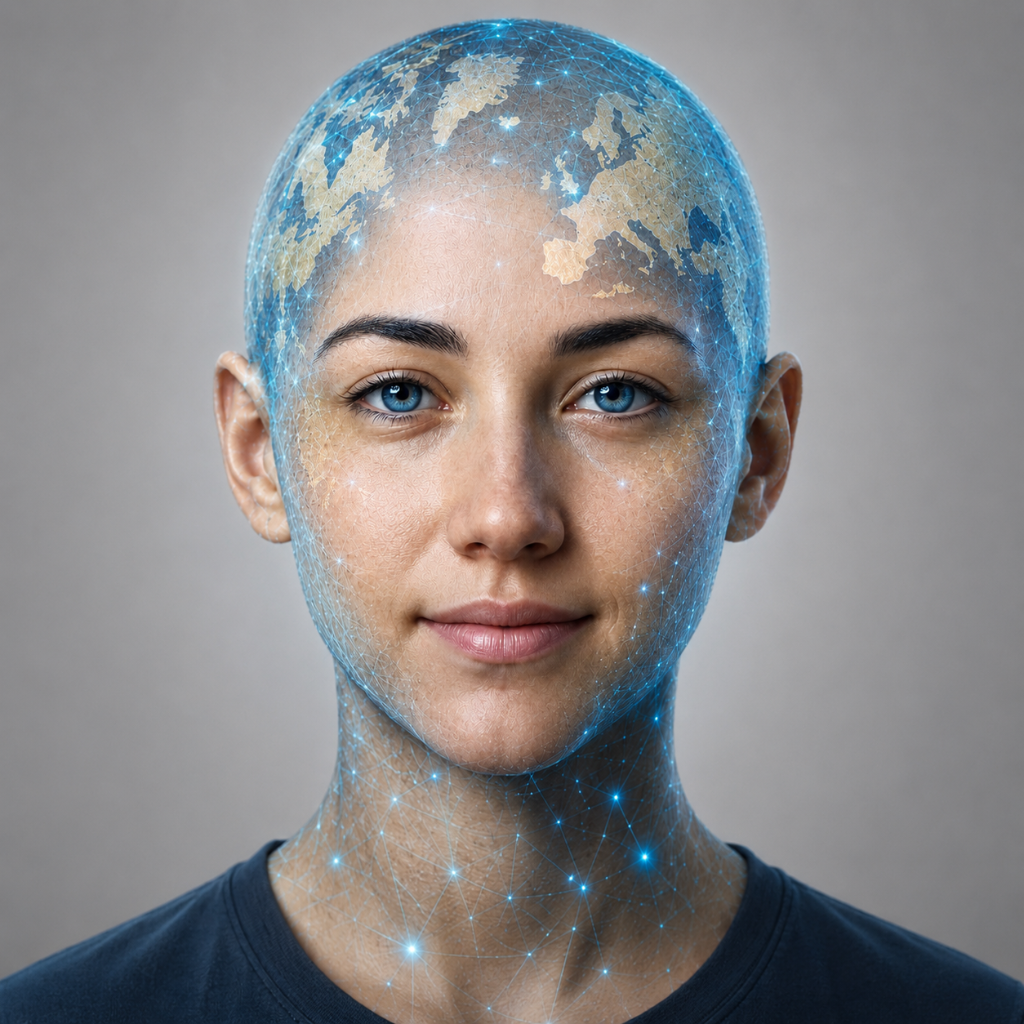
I arrived at the UnitedPeoples (UP) campus just after dawn, when the Maas still held the light like a secret. The mirrored façade of the UP Museum of Leadership threw my reflection back at me, and with it the inscription etched across the atrium’s inner glass: If you are reading this, you are already in the Museum. Ten years into the movement, it no longer reads like metaphor. By the organisation’s own count, nearly a million people have walked these galleries since 2030, and more than 60 million have visited the virtual counterpart. Today, as the Tenth UP Congress opens, the Museum projects the faces of almost 1,700 historical inductees — up from roughly 400 by Year Five — across its skin like a living atlas of how humanity has led, failed, tried again, and led better.
What is striking, here and now, is how deliberately UnitedPeoples collapsed the distance between remembrance and practice. The Museum sits in a tight holarchy — nested wholes within wholes — with UP Academe and the movement’s head office: memory, learning and coordination sharing one civic bloodstream. It began quietly in Year Two with a virtual museum of deceased figures nominated across all 15 GlobalCircles, then stepped into the world in Year Five with a €250 million complex and a new ritual: the first living inductees joining the chorus of the dead. Since then, travelling exhibitions with major institutions have taken the archive on the road — and the road, in turn, led back here.
Inside, the LC&M curators — Leadership Coaching & Mentoring — remind me, gently, that this GlobalCircle and its sibling, Human Development, were never meant as guilds for a single sector. They are the scaffolding that runs across every sector, through which everything else moves. LC&M is in the business, they say, of growing leadership as a transferable competency — sense-making, ethical courage, facilitation, boundary-spanning (working across divides), regenerative vision, care under pressure, self-mastery — habits any person can learn to practise inside Projects across every other domain.
By 2035, LC&M has matured into one of UnitedPeoples’ two connective backbones, responsible for the leadership culture that binds the ecosystem together. LC&M’s membership now stands at roughly 25 million — about 6 per cent of all GlobalCircle affiliations. Within its structure sit around 8,200 ThemedCircles, some 41,000 BrandedCircles and roughly 660,000 active Projects, spanning everything from formal mentoring networks to corporate-governance labs and youth-leadership fellowships. It is among the movement’s most-joined domains — a civic architecture of learning and accountability large enough to rival most national education systems.
Looking back from 2035, it is hard to overstate the gravity of that evening in Rotterdam five years earlier.
The Fifth Annual UP Congress — the year the Museum of Leadership opened its doors — did more than open a building. It redrew leadership.
The Night Everything Changed
Until then, the world’s great gatherings still belonged to the old order. Davos, once the default summit of consequence, had begun to lose its moral traction; its vocabulary of influence felt threadbare against systemic crisis. Then came the Rotterdam Congress, and nothing was quite the same again.
The Museum’s glass canopy became a stage for the first fifteen living inductees, one from each GlobalCircle. Ten thousand people filled the plaza; millions watched online as the holographic faces of four hundred historical figures shimmered above them, projected across the river in a cathedral of light.
From that night onward, the world had a new lexicon for leadership. The criteria for induction — first introduced that evening and now woven into NAVi’s competency model — were simple yet radical: tenacity; leading by example; vision-making; service for others; unity and consensus-building; integrity and core values; and community elevation. They were the quiet virtues the twenty-first century had almost forgotten, spoken aloud again at a scale large enough to echo.
The fifteen inductees came from every domain: a playwright who built peace through narrative; a logistics engineer who restructured post-crisis supply chains; a mayor who turned flood recovery into democratic renewal; a physician, an activist, a scientist, a teacher. None stood as icons; all stood as evidence.
NAVi’s voice filled the atrium that night, its tone somewhere between human and hymn:
“For five years we remembered the dead who showed us how to lead. Tonight, the living join them — and leadership becomes a verb again.”
Each inductee lifted a lantern that triggered a cascade of light through the canopy, one beam for each GlobalCircle, converging above the crowd into a single point of radiance. The image became a global symbol within hours.
That night in 2030 marked the shift: leadership as culture rather than credential, and UnitedPeoples organising example rather than power.
In 2030, leadership stopped being a title and became a culture.
The Idea That Started It All
Those who helped conceive the Museum remember it starting as a simple proposition: before you could build a future of leadership, you had to collect its stories. The first sketches were online — a humble catalogue of women and men who embodied perseverance, service, integrity, vision, unity and community elevation. Their imperfections were part of the point. Each story was meant to provoke discussion, not veneration: to show that leadership was less about perfection than persistence, and that every act of moral imagination, however small, was worth recording.
From that seed grew a digital experiment, then pop-up installations in community halls, then travelling exhibitions. The aim was never a hall of fame but a practice — a place to see ourselves as works in progress. The Museum that stands in Rotterdam today is the mature expression of that early faith: that humanity could learn from its best instincts if it remembered them together.
If ThemedCircles are the network’s precision tools, LC&M’s two flagships are the easiest to spot here in Rotterdam. ThemedCircle: MentorMatch is LC&M’s connective tissue — an always-on pairing system that routes members by competency rather than job title. In the hour before Congress opens, I watch a MentorMatch pod in action: a paediatrics charge nurse from Lagos and a port-logistics supervisor from Santos rehearsing “speaking truth across hierarchy.” The second flagship is the UP Museum of Leadership itself, whose living archive now stretches from nineteenth-century reformers to contemporary civic technologists. A floor below us, a class from a Rotterdam comprehensive tours an installation that pairs a Wangari Maathai oral-history hologram with live footage from a regenerative-agriculture Project in the GC for Sustainability Climate & Food.
But the real accelerant these past five years has been the rise of BrandedCircles — partner-hosted communities of practice that carry LC&M’s shared grammar into existing institutions at scale. You meet them everywhere on campus this week. BC ICF (the International Coaching Federation) has turned a hall off the main atrium into a hands-on practice lab, running rolling clinics on team facilitation and conflict navigation — exactly the competency-level coaching LC&M insists belongs on factory floors and clinic wards as much as in executive suites. In a nearby gallery, BC BMW exhibits a leadership-in-manufacturing playbook born of a three-continent apprenticeship programme. Across the forum, BC Greenpeace hosts a boundary-spanning workshop with young organisers from the GC for Government Politics & Public Sector. The BrandedCircles were always meant to be pragmatic on-ramps: third-party institutions that align with the Tenets, install the tools, and prove — inside their own worlds — that leadership can be made ordinary without being made any less exacting.
Lives That Changed the Course of Their Own
For all its scale, the Museum’s impact is easiest to see one life at a time.
In Nairobi, twenty-four-year-old entrepreneur Amira Wanjiku joined LC Nairobi/Westlands in 2031. Through MentorMatch she was paired with a sustainability coach from São Paulo and a financier from BC BMW. Together they turned her local composting start-up into a pan-African cooperative funded through UP’s embedded-finance micro-loan platform. Amira now mentors others, calling the system “the first network that treated my idea like an ecosystem, not a pitch.”
In Ecuador, high-school teacher Lucía Menéndez was matched with a retired diplomat through the Public Leadership and Statesmanship ThemedCircle. Their collaboration produced a bilingual civic-literacy curriculum that spread across the Andean region, earning Lucía a promotion and a sense of global kinship. “I stopped feeling small,” she told me. “Leadership stopped meaning rank; it started meaning reach.”
And in Warsaw, a logistics analyst named Piotr Nowak found his own business acumen by coaching peers in the Resilience and Self-Mastery Circle. The confidence and network he built there led him to found a purpose-driven consultancy that now employs forty people. He credits ACE — the Appreciative Collaborative Exploration method — for teaching him “how to turn critique into curiosity, and curiosity into a business.”
Each story ends the same way: material success arrived almost incidentally, a side effect of learning to lead differently. LC&M’s promise — that members would do better by being better while doing good — has, by 2035, become more than a slogan. It is a pattern.
It helps that the method travels well. Appreciative Collaborative Exploration is everywhere on campus this week: in the way a curator frames a question, in the way a MentorMatch debrief asks for evidence before opinion, in the way a BrandedCircle coach flips a room from “What went wrong?” to “What worked, where, and why?” It shapes the curation, too. Exhibits are arranged not by personality but by competency. An alcove on care under pressure moves, without apology, from a mid-century ward matron to a neighbourhood organiser who kept a community kitchen open through a flood. Another, on boundary-spanning, sets a wartime code-breaker beside a twenty-something who built an open-source translation layer for the UP HUB’s LC onboarding tool.
The numbers are the headline, but the human texture is the story. A docent tells me the induction pipeline matured from a trickle to a river after Year Five: nominations flowing up from LocalCircles, validated by GlobalCircle panels, and curated by the Museum’s cross-domain board. That is how the archive grew from about 400 historical figures in 2030 to nearly 1,700 by this Congress — less a pantheon than a distributed autobiography. Outside, a banner sums up the logic in a single line: from exceptionalism to exemplarism.
The movement’s critics — there are a few on the riverside today, mostly holding placards about “technocracy” — argue that leadership can’t be templated without draining the life from it. It’s a fair worry. Inside, I put it to one of LC&M’s programme leads, who shrugs. “We’re not templating people,” she says. “We’re templating practice. If a ward learns to de-escalate without shame, or a town hall learns to hear itself, that’s a cultural upgrade. The competency is the point; the glory belongs to the work.”
That philosophy is baked into the Museum’s most arresting room, The Commons, where induction plaques give way to live Projects. This morning a rotating wall throws up a grid of sessions happening in real time: an LC mediation in Manila; a climate-resilience rehearsal in Mombasa; a school-governance redesign in Kraków. You can step from the grid into a seat, from a seat into a pod, from a pod back into your own city with a script in your pocket and a mentor one tap away. As the curators like to say, the building doesn’t so much store leadership as host its rehearsals.
The Museum is where leadership is rehearsed in public.
The afternoon crescendo is the opening of Congress proper. A thousand delegates from all fifteen GlobalCircles stand beneath the atrium’s mirrored canopy while NAVi, the movement’s AI guide, reads the names of this year’s inductees and threads them — visibly, audibly — into Projects that owe them a debt. The living inductees were the first to join this roll in 2030. Today the ritual lands with a soft finality. No statues, no busts. Each living inductee lights a small beacon that pairs, automatically, with a MentorMatch invitation to anyone in the hall practising the same competency. To lead is to be of use, the gesture seems to say.
It’s hard to avoid the sense that LC&M is now living with the consequences of its success. Its scaffolding — the TCs, the BCs, the pods and playbooks — has spread so widely that the Circle risks dissolving into the culture it helped create. On my way out I ask a curator if that worries her. “It delights me,” she says. “We designed ourselves to become infrastructure. When you can’t see the bridge any more, you’re on it.”
On the tram back to Centraal, I scroll the virtual museum on my phone. A child beside me is doing the same, tracing a path from a twentieth-century nurse to a twenty-first-century logistics lead — the very pairing I watched in the pod this morning. If LC&M has proved anything in ten years, it is that leadership is not a summit but a circulation. The Museum’s mirror — you are already in it — is less an invitation than a reminder. In Rotterdam you can feel it take hold: not of who the great once were, but of who we are when we lead each other well.