I spent this afternoon at Mauthausen.
If you don't know it: a concentration camp on a hill above the Danube, a few hours upstream from Vienna. Between 1938 and 1945, about 190,000 people were imprisoned there. At least 90,000 of them died.
I expected to be confronted by evil, and I was. What I did not expect was how ordinary it would look.
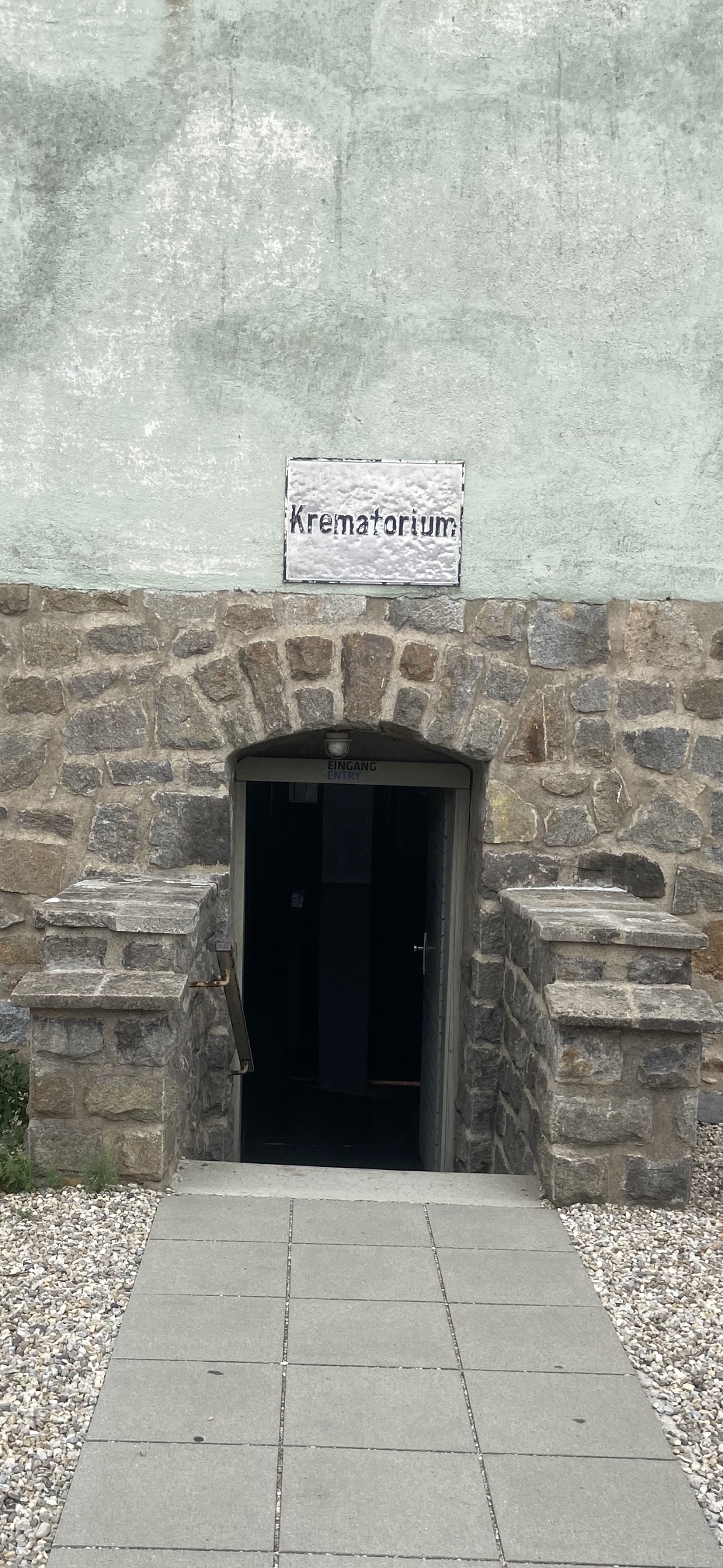
Mauthausen was a business. An SS-owned company ran the granite quarry below the camp. Prisoners carried the stone up 186 steps on their backs until the work killed them. The granite paved Vienna and was meant to rebuild Linz as a showpiece city. Contracts were signed. Invoices were paid. The camp sat in plain view of the town below.
And the cruelty was deliberate. Prisoners were marched past the swimming pool the SS officers swam in. Beside the camp, the SS kept a football pitch, where they played teams from the neighbouring towns - matches with spectators, a short walk from the barracks.
In 1941, a local farmer filed a written complaint with the authorities. From her field she could see prisoners being shot. She did not ask that the killing stop. She asked that it be done where she could not see it.
In February 1945, close to five hundred Soviet prisoners broke out of the camp at night. The SS called on the district to hunt them down, and many neighbours joined in - police, home guard, Hitler Youth, farmers. They called it the Mühlviertler Hasenjagd - the great hare hunt. Eleven are known to have survived the war.
Here is what I keep turning over. Austria and Germany in those years were among the most educated, cultured, lawful societies on earth. Most Germans never voted for the Nazis. The people of that town were not monsters. They were teachers, shopkeepers and churchgoers. By almost any measure we use, they were good people.
That is the real warning of Mauthausen. Not that evil people exist - of course they do. The warning is that good people, and good peoples, can effect evil. A society can corrupt itself. It happens by degrees: fear first, then silence, then habit, until decent people ask only that the cruelty be kept out of sight.
But evil is only half of the story the hill tells.
Two of the eleven survivors lived because of a farm family named Langthaler. Maria Langthaler, whose own sons were away fighting in the German army, hid two escaped Soviet officers in her house for three months. She risked her whole family's lives to do it. Asked later why, she gave no grand reason. It was simply the decent thing.
A woman in the town, Anna Pointner, hid photographic negatives that a Spanish prisoner smuggled out of the camp's photo lab. She kept them in a crack in her garden wall. After the war, those photographs became evidence at Nuremberg.
And it was not only there. A village in the hills of France quietly sheltered thousands of Jewish refugees; asked why, its people shrugged - things had to be done, and they were there. In October 1943, Danish fishermen ferried more than seven thousand Jews to safety in Sweden in a few weeks, warned by a German diplomat who could not stomach what was coming. In Budapest in 1944, a young Swedish diplomat named Raoul Wallenberg handed out protective passports by the thousand and pulled people off deportation trains - tens of thousands saved, before he himself vanished into Soviet custody.
Nor did it stop with the war. At the height of the Cold War, a Soviet scientist proposed, and an American led, the campaign that erased smallpox from the earth - a disease that killed some 300 million people in the twentieth century alone. Strangers vaccinated strangers across every border on the planet, and now it is gone. An Australian named James Harrison, told that his rare blood plasma could protect newborns, donated more than a thousand times over sixty years. Millions of babies are alive because one man kept showing up.
I am not a religious man. I don't believe humanity needs deities to worship. Standing at Mauthausen, I was more certain of that than ever - because everything that happened on that hill, the worst of it and the best of it, was done by human beings. No commandment made Maria Langthaler open her door. No god erased smallpox. That kind of goodness lives in us, and when I look at it squarely, the only word for what I feel is wonder.
So the question is not whether people are good. Most people, most of the time, are. The question is which of our capacities gets organised. At Mauthausen, cruelty was organised - meticulously, profitably, lawfully - while goodness was left to a farmhouse here, a garden wall there.
And we should be honest: the signs are no longer faint. The old sequence is running again - now, in the countries that swore Never Again. Neighbours spoken of as categories, then as threats, then as less than human. Cruelty performed in public and applauded as strength. And decent people - millions of us - concluding that the wise course is to keep their heads down. I am seventy. I did not think I would live to see it. The hill at Mauthausen is plain about where this goes, and plain that it does not stop on its own.
Recognising the signs is not a counsel of despair. It is a statement about timing: the time to build is now, while building is still possible.
Eighty years ago, Frank Capra made a series of films for ordinary soldiers called Why We Fight. They answered a plain question - why am I being asked to put my life on the line? This essay is my attempt at the same question, asked of a builder rather than a soldier, at seventy rather than twenty.
Here is my answer. Our problem is not a shortage of good people. It is that goodness is scattered, while cruelty organises fast. At Mauthausen, the evil is what you see. The decency you have to be told about. And that decency - the farmhouse, the garden wall, Denmark, France, Budapest, the smallpox wards - needs what cruelty had: structure. A place to gather. Ways to support one another. Work to do together. That is what we are building at UnitedPeoples: a civic home designed for millions of people to form real community, back one another, and act together on what they care about - so that the Langthalers of this world are never alone again.
We speak at UP of an Age of Thriving. After today, I would put it more plainly. That aspiration must prevail. History will not bend there on its own. Enough of us have to build it.
Mauthausen, Austria - October 2026
Sources
- Mauthausen Memorial (mauthausen-memorial.org): the camp's history and figures; the 1941 written complaint of farmer Eleonore Gusenbauer; the escape from Block 20 in February 1945 and the Mühlviertler Hasenjagd; the Langthaler family; Anna Pointner and the negatives smuggled from the camp photo lab by prisoner Francesc Boix, in evidence at the Nuremberg trials.
- Yad Vashem, Righteous Among the Nations: the village of Le Chambon-sur-Lignon; the rescue of the Danish Jews, October 1943, forewarned by the German diplomat Georg Ferdinand Duckwitz.
- United States Holocaust Memorial Museum: Raoul Wallenberg, Budapest, 1944.
- World Health Organization: smallpox declared eradicated, 1980 - the programme proposed by Viktor Zhdanov (1958) and led by D. A. Henderson.
- Australian Red Cross Lifeblood: James Harrison, 1,173 plasma donations, 1954 to 2018.
- Frank Capra, Why We Fight, US War Department film series, 1942 to 1945.