Today, unitedpeoples.earth went live.
Until now, a spare page stood at this address — enough to honour the transparency a Dutch public-benefit foundation owes, and deliberately no more. What replaces it is the product of a months-long exercise we set ourselves: refine the value proposition until it holds, document it completely, and make it accessible to anyone who walks up. That work is now public, and the milestone deserves marking.
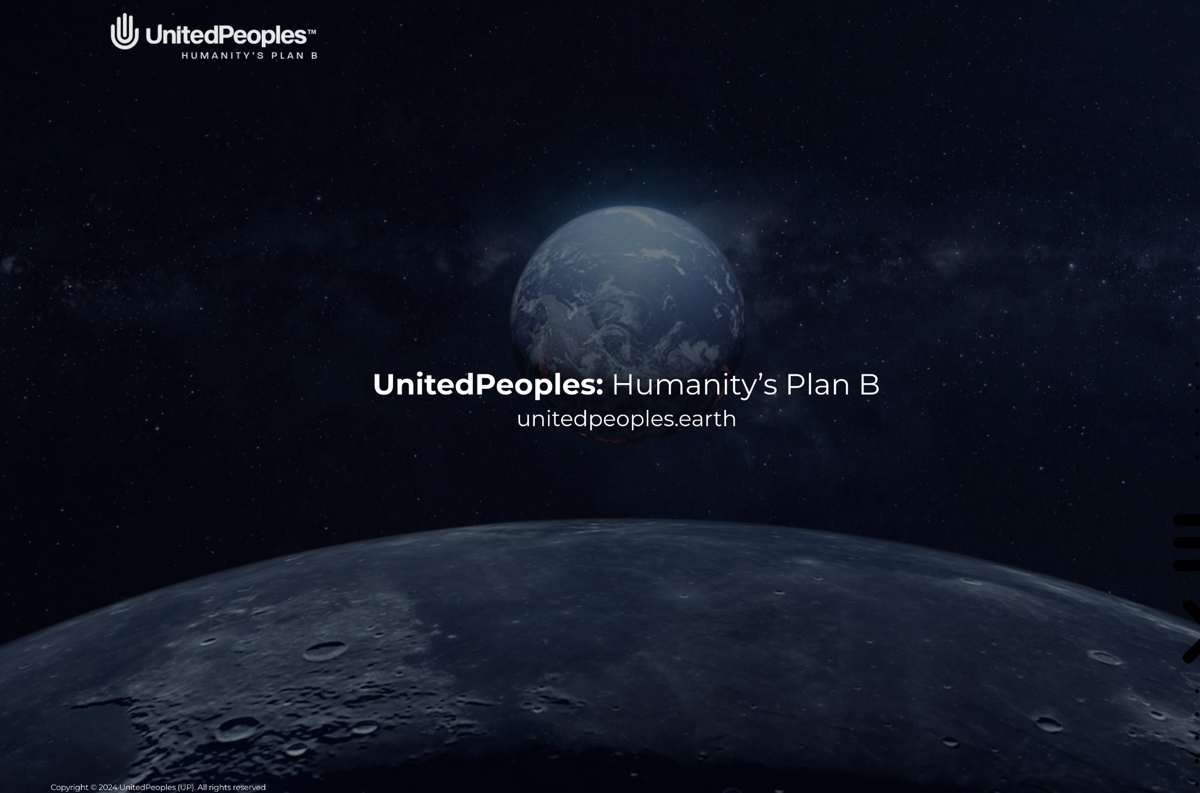
Begin with what greets you: Earth, rising over the Moon. In 1968, a photograph taken from lunar orbit let humanity see its home whole for the first time — one world, luminous, undivided, not a border anywhere in sight. That image changed what “we” could mean, and everything on this site is built for that “we”. It is also the thread that ties this site to its predecessor: Earth above the Moon stood on the spare page too — a rendering then, the photograph now. The view stays. What stands behind it has changed.
The site now carries the whole case: the moment we believe this is, how the institution works, the numbers it runs on, and the plan that carries it from a few people in The Hague to a hundred million members — and with them, toward an Age of Thriving by 2035. The timing is not casual. This is a decade in which much that we count on will be decided, and institutions equal to it are built before they are needed.
And then there is the introduction we have waited longest to make. Meet NAVi.
NAVi is UnitedPeoples’ navigator, and from today anyone can talk with NAVi — text or voice, in 82 languages, right on the site. Ask what UP is, how a Circle works, what the plan costs, why we believe it can be done: NAVi answers from the published record, patiently, at three in the morning if that is when the question arrives. An institution built for a hundred million members cannot make its case one meeting at a time — NAVi is how the case reaches everyone. Step into the UP HUB 2032 demo and NAVi will walk you through the institution as a member will one day live it. NAVi is an AI, clearly labelled as one — and, we think, the first colleague of a kind every serious institution will soon have. You will be seeing a lot of each other.
For those who want to go deeper, the Due Diligence Portal opens the workings — the documents, the models, the governance. We built for scrutiny. Use it.
We call this a beta, and we mean the word. For the next two months the site runs with early adopters — tested, argued over, refined in view — with the full public launch planned for mid-September. What you see will change as the work changes: refined, replaced, and recorded when it is. A site that never changed would mean the work had stopped.
History rarely announces itself. It usually looks like a small group of people deciding not to wait. Look around. Say hello to NAVi. The doors are open — and they were built for you to walk through.
Sources — every external claim on this site is cited and dated at /sources.