I have spent fifty years watching experts at work - from the bottom of the ladder when I started out, and from the top once I had co-founded a Big Five e-commerce practice and then built a company of my own. For the last ten of those years I have been making the case that our biggest problems need answers built at the scale of the whole system rather than one piece at a time. The need seemed obvious. What has surprised me is how often the people best placed to see it did not. Some could not. More would not. Through those ten years I have watched something insidious stand in the way. I have come to call it expertitis: the inflammation of expertise, the point at which what you know starts to decide what you can see.
Four years ago I wrote that 'focusing on focusing' had stopped working, that we had spent decades slicing every big problem into smaller and smaller 'workable' pieces until the solutions got too small to matter. I was right, but not right enough, because the problem is no longer our methods. It's us. We all talk about silos. We are each becoming one.
Consider the case of John Harrison.
In 1714 the British Parliament put up £20,000 - a king's ransom - for anyone who could tell a ship its longitude at sea, and every learned man in Europe knew the answer would come from the stars. Harrison was a joiner from Yorkshire who taught himself to make clocks, and he spent nearly thirty years building the answer: a sea clock that kept time on a rolling deck in 1735, a better one in 1741, a third that took him nineteen years, and finally a watch that crossed to Jamaica in 1762 and was five seconds out. Five seconds, after three decades of work. The Board of Longitude - stacked with astronomers - then spent eleven years finding reasons not to pay him. The Astronomer Royal had his own method, built on lunar tables - hours of calculation for an answer nowhere near as precise - and a carpenter's clock was not the kind of answer the question was supposed to have. Harrison was paid in full in 1773, at eighty, after the King himself stepped in. He died three years later. [1]
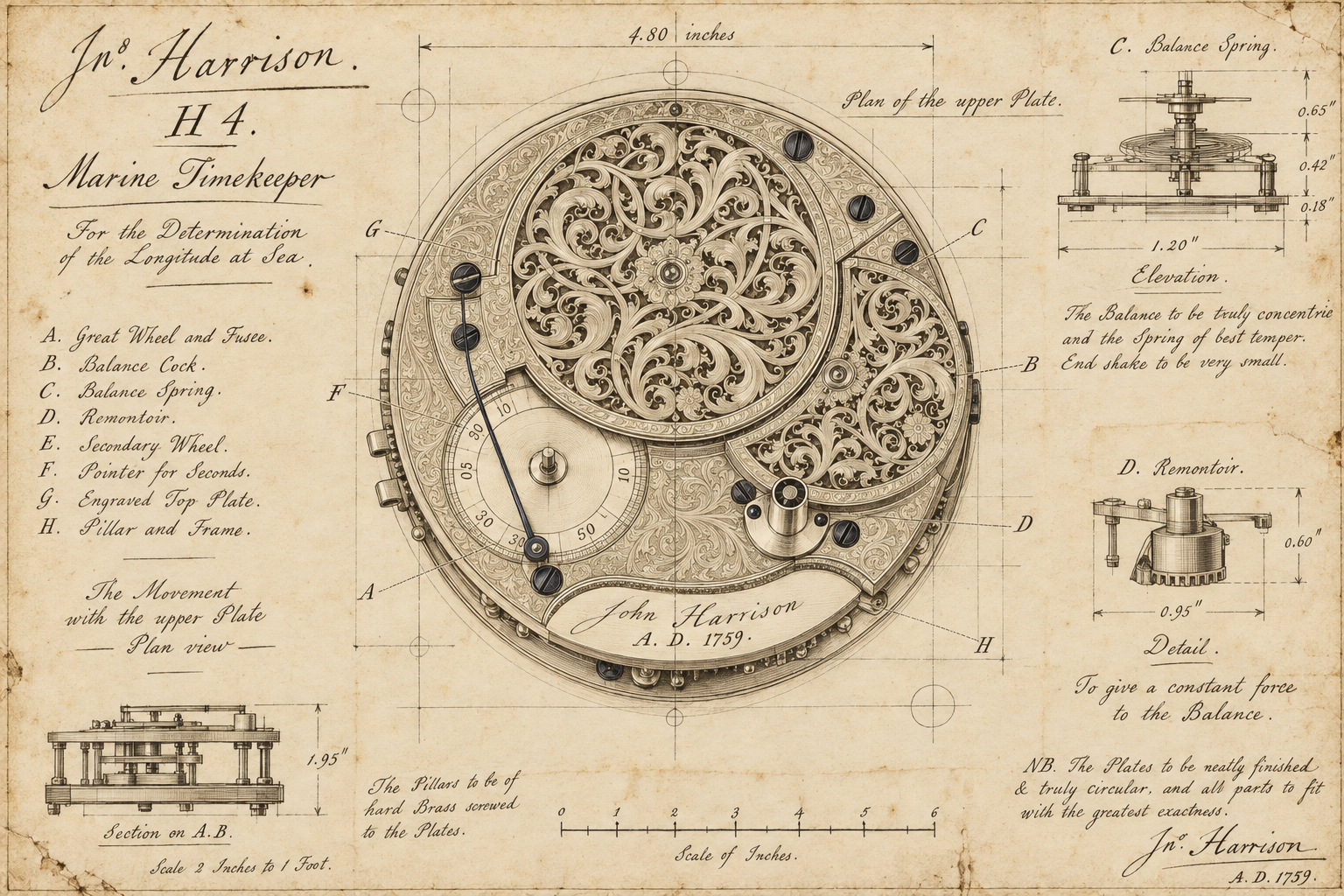
The astronomers didn't miss the answer. They decided in advance which profession the answer had to come from, and then spent forty years measuring a carpenter against that decision.
Once you see the pattern, you see it everywhere.
Alfred Wegener, a weatherman, proposed in 1912 that the continents drift, and the geologists laughed at the outsider for fifty years. Plate tectonics proved him right, long after he had died on the Greenland ice in 1930. [2] Ignaz Semmelweis cut the deaths in his Vienna maternity ward to a fraction in 1847 by making doctors wash their hands. The profession rejected him, because his finding said that doctors were killing their patients, and he died in an asylum before germ theory made him right. [3] In 1984 every gastroenterologist knew that ulcers came from stress and stomach acid. Barry Marshall said they came from a bacterium, and when his profession would not hear it he drank a beaker of the bacteria and gave himself the disease to prove it, earning him the Nobel Prize in 2005. [4]
Money is no guarantee of prescience. In October 1929 the most famous economist in America told a New York dinner that stock prices had reached 'a permanently high plateau'. The crash began nine days later. [5] In 2008, two months after the collapse of Lehman Brothers had set off the worst financial crisis in eighty years, the Queen opened a building at the London School of Economics and asked the professors a simple question: why did nobody notice? When the economists wrote back the next summer, they said the failure was one of collective imagination - many bright people who each understood their own piece, and no one who understood the risks to the system as a whole. [6] Read that again. Every specialist was right about his specialty. Nobody's job was the whole.
Nor does running the field protect you. In 2007 Steve Ballmer, the chief executive of Microsoft, famously laughed at the iPhone on camera - 'no chance', he said, of any significant market share. His reasoning was the expert reasoning that had built Microsoft, and it was exactly what stopped him seeing the phone in front of him. [7]
And too often, people die. In 2008 the company that ran the Fukushima nuclear plant in Japan estimated that a tsunami of nearly sixteen metres could hit it. The executive in charge put the defences on hold and asked the experts to re-check their estimates. The anticipated wave came in 2011, about fourteen metres high; it knocked out the plant's power and three reactors melted down. A hundred and sixty thousand people were driven from their homes, many for good; within two years the evacuation had killed more people in the prefecture than the wave itself; and the clean-up is priced at nearly two hundred billion dollars and forty years. The company's defence afterwards was that the experts had disagreed. [8] In January 1986 the engineers who built the Challenger shuttle's booster rockets argued against launching in the cold. A manager told their chief to take off his engineering hat and put on his management hat. The shuttle broke apart seventy-three seconds after lift-off and seven people died. It took an outsider, the physicist Richard Feynman, dropping a piece of the rubber seal into a glass of iced water at a televised hearing, to show the country what the institution could not hear from inside. [9]
Why? Certainly not stupidity. These were the brightest people in their fields. That is the point.
Here is what the disease looks like in a laboratory. Researchers gave chess masters a scenario with two winning moves, one familiar and one better. Nearly every master found the familiar move first. Asked to keep looking for something better, they said they were - but the eye-tracker showed their gaze stuck on the squares of the move they had already found. Knowing the first answer stopped them seeing the second, and it dropped their play to the level of players roughly three skill classes below them. [10] The expert believes he is looking when he is not. What he already knows has taken over his eyes.
It is a failure of imagination - but not for want of it. The masters imagined furiously, along the lines their knowledge had already drawn. Knowing does not stop us imagining. It tells our imagination where to go before it sets out, and it tells us what shape the answer is allowed to have. And whatever we cannot imagine we file, without ever noticing, as impossible. If you cannot imagine it, how could it be possible? The astronomers could imagine a better set of lunar tables. They could not imagine a clock. So a clock could not be the answer, and a carpenter waited forty years.
And the disease feeds itself. Once we know a field, we expect the world to arrive in our language. Our jargon. Our metrics. Our frameworks, our charts, our way of putting a case. Anything that turns up in someone else's vocabulary fails the test before it has been heard. Wrong has nothing to do with it; it simply does not look serious to us. We call this rigour. It is a filter, and it screens out exactly the possibilities we could not already imagine, because those are the ones that never arrive in our terms. The carpenter did not submit lunar tables. The weatherman did not publish in the geology journals. Ballmer measured the iPhone in the number that had built Microsoft - share of phones running his software - and by that number it was a toy. So we are fed pablum: the already-known, pre-chewed, served by people who speak as we speak, and we mistake the familiar for understanding. New imaginings are risky. They ask us to learn a language, doubt a metric, admit a gap. What we already believe costs nothing. So we stay where we are, and call it judgement.
Philip Tetlock spent twenty years scoring the forecasts of nearly three hundred experts, and the ones who knew many small things routinely beat the ones with one big theory. Here is the part that should keep us up at night: the big-theory experts got WORSE as they collected more credentials, because more facts meant more ways to confirm what they already believed. [11]
And we license it. Asked directly, people say it is more acceptable for an expert to be closed-minded than for a novice, and people who imagine themselves in the expert's chair expect to be more closed-minded too. [12] We grant ourselves the silo. Then we live in it.
There is a word for this - actually there are several, because we have been diagnosing it for a century, each time from inside a different specialty. Thorstein Veblen gave us 'trained incapacity' a century ago. Ortega y Gasset, in 1930, called the specialist a 'learned ignoramus' - a man who knows his tiny corner of the universe, is radically ignorant of the rest, and behaves in every matter with the confidence of the learned. Isaiah Berlin gave us the hedgehog who knows one big thing, and the psychologists now say 'cognitive entrenchment'. [13] An economist, a philosopher, a historian and a psychologist - one disease, four names.
Now, everything above could be read as a case against experts, and it is precisely the opposite. Expertise is why a child born today can expect to live twice as long as one born two centuries ago, why aeroplanes almost never fall out of the sky, why the bridge holds and the vaccine works. Harrison, Semmelweis, Marshall and Feynman were experts to their fingertips. Every advance in this essay came from someone who knew a great deal - and every one of them was blocked by someone who also knew a great deal. Nobody wants a generalist flying the plane. You are reading this because you are an expert in something - you built a company, a practice, a portfolio, a body of work - and so did I, and I have caught this disease more than once, as has everyone who is good at anything. Which is why the disease has to be named for what it is. Expertitis is expertise held ALONE.
Look again at the cures. A weatherman walked into geology, a physicist sat on an aerospace commission, a doctor drank the beaker to make his own profession look, and the two men who backed Harrison early were an astronomer and a clockmaker standing together. The economists' confession to the Queen said it plainly: every piece was understood, and the whole was owned by no one. The research says the same thing in its own language - experts stay flexible when they work in changing surroundings and pay attention to problems outside their own field. [13] In plain words, the cure for expertitis is company. Different company. People who don't share your training, sitting close enough to ask the question you stopped asking twenty years ago.
That is why I submit this is more dangerous than the problem I wrote about four years ago. Focusing on focusing was a habit of method, and methods can be changed on a Monday morning. Expertitis is a habit of identity: we are our expertise, paid for it, promoted for it, introduced by it at dinner. We no longer work in silos. We have become them. And every problem now in front of us lives in the joints between the silos, where nobody is the expert and everybody is needed.
So here is what I ask, of you and of me. Not a task. A look in the mirror. Think back over the last year. When did someone outside your field tell you something about your field, and what did you do with it? When did you last change your mind because of a person with no standing in the matter? When did you last decide, before you had heard the answer, which kind of person it would have to come from? And what did you call impossible this year that you had simply never imagined? If the answers come slowly, you have felt the inflammation. That's the diagnosis, and it is not a verdict. The cure is company - different company - and it starts with the next conversation you have with someone who knows nothing about what you do, and with opening your mind to realms of the possible you have not yet imagined.
Harrison waited forty years to be heard. The problems in front of us will not wait forty years for us to hear each other. Somewhere near you, right now, is a carpenter with a better clock. Go and look.
Sources
- 1. Dava Sobel, Longitude (1995); Royal Museums Greenwich, which holds Harrison's H1 to H4.
- 2. Naomi Oreskes, The Rejection of Continental Drift (1999).
- 3. Sherwin Nuland, The Doctors' Plague (2003).
- 4. Nobel Prize in Physiology or Medicine 2005, nobelprize.org.
- 5. New York Times, 16 October 1929, reporting Irving Fisher's speech of 15 October.
- 6. Letter to HM The Queen from the British Academy, 22 July 2009.
- 7. USA Today interview with Steve Ballmer, April 2007.
- 8. Asahi Shimbun, 'Document shows TEPCO recognized risk of huge tsunami at Fukushima plant in 2008' (2015); Mainichi trial reporting (2018); Fukushima Prefecture disaster-related death figures, as reported August 2013; Japan Ministry of Economy, Trade and Industry cost estimate, December 2016 (¥21.5 trillion; decommissioning over four decades).
- 9. Report of the Presidential Commission on the Space Shuttle Challenger Accident (1986).
- 10. Bilalić, McLeod and Gobet, 'Why good thoughts block better ones', Cognition (2008).
- 11. Philip Tetlock, Expert Political Judgment (2005); the finding as summarised in Nate Silver, The Signal and the Noise (2012).
- 12. Ottati et al., 'The earned dogmatism effect', Journal of Experimental Social Psychology (2015); replication by Calin-Jageman (2018).
- 13. 'Trained incapacity' is attributed to Thorstein Veblen and was popularised by Kenneth Burke, Permanence and Change (1935), and Robert K. Merton (1940); José Ortega y Gasset, The Revolt of the Masses (1930); Isaiah Berlin, The Hedgehog and the Fox (1953); Erik Dane, 'Reconsidering the trade-off between expertise and flexibility', Academy of Management Review (2010).